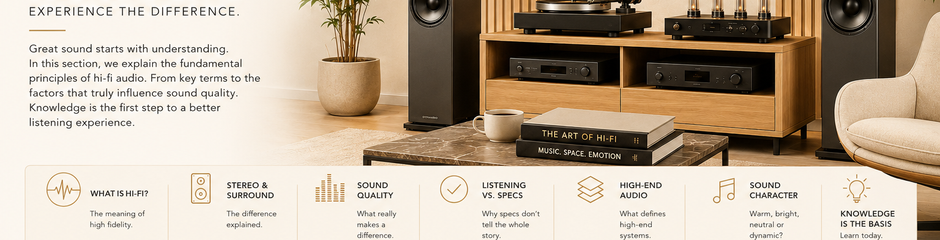
What Is Hi-Fi Audio?
Understanding High Fidelity Sound
Hi-Fi stands for High Fidelity. In simple terms, it means sound reproduction that stays as close as possible to the original recording.
A good Hi-Fi system does not try to impress you with exaggerated bass, sharp treble or artificial effects. It tries to reproduce music in a natural, balanced and detailed way. The goal is simple: to hear the music as the artist, producer and recording engineer intended it.
More Than Just Loud Sound
Many people confuse good audio with loud audio. But volume is not the same as quality.
A real Hi-Fi system gives you more than power. It gives you:
Clear vocals
Natural instruments
Controlled bass
Detail without harshness
A realistic stereo image
Space and depth in the music
Emotion and musical flow
When a system is well balanced, you do not just hear the music. You feel the performance.
The Hi-Fi Chain
A Hi-Fi system is built like a chain. Every part influences the final result.
The main elements are:
Source
The place where the music starts, such as a streamer, turntable, CD player or digital file.
DAC
A Digital-to-Analog Converter that converts digital music into an analog signal.
Amplifier
The component that gives power and control to the speakers.
Speakers
The final step that turns the electrical signal into sound waves.
Cables and connections
The links between all components.
Room acoustics
The space where the music is played. The room can strongly influence the sound.
The listener
Your ears, taste and emotional connection are always part of the experience.
If one part of the chain is weak or poorly matched, the complete system can lose quality.

Hi-Fi vs Regular Audio
Regular audio systems are often built for convenience. They are made to be compact, easy to use and suitable for background music.
Hi-Fi audio goes further. It focuses on quality, balance and realism.
The difference is often heard in the details. A good Hi-Fi system reveals the texture of a voice, the natural resonance of a piano, the space around a guitar or the subtle energy of a live recording.
It does not simply play music. It opens the recording.

Why Specifications Do Not Tell the Whole Story
Specifications can be useful, but they do not explain everything. Watts, frequency range and technical numbers only tell part of the story.
Two amplifiers with similar specifications can sound completely different. Two speakers with the same size can create a totally different experience.
The real quality of a Hi-Fi system depends on:
Component matching
Build quality
Speaker placement
Room acoustics
Power control
Source quality
Personal listening preference
That is why listening remains essential.
The Role of the Room
Your room is part of your Hi-Fi system. Hard walls, glass, empty floors and large open spaces can create reflections, echo and uncontrolled bass.
A well-placed system in a balanced room often sounds better than a more expensive system in a poor acoustic environment.
Good sound is created by the combination of equipment, placement and space.

What Makes Hi-Fi Emotional?
The best Hi-Fi systems disappear. You stop thinking about speakers, cables and amplifiers. Instead, you hear the voice, the instrument and the emotion behind the music.
That is the real purpose of Hi-Fi.
It is not about technology for the sake of technology. It is about creating a deeper connection with music.

Conclusion
Hi-Fi audio is about faithful music reproduction. It is about clarity, balance, realism and emotion. A good system brings the recording closer to you and allows you to experience music with more depth and detail.
At YourAudio, we believe that great sound starts with understanding. When you know how a Hi-Fi system works, you can make better choices and build a setup that truly fits your music, your room and your way of listening.
Hi-Fi is not just better sound. It is a better music experience.